
When it comes to investing, I have been a late bloomer. I started my investing journey in my 30s (and that’s quite late). Throughout my 7-8 years of investing, I’ve been hesitant of investing directly in stocks and hence have stuck to the traditional approach of sticking to mutual funds. This was until 2020 post pandemic, when I was reviewing my investment strategy and exploring various options. While browsing YouTube, I serendipitously came across Smallcase.
Post COVID19 onset, retail investors had a lot of disposable income as general consumption dropped. This is evident from the fact that new Demat accounts that opened in FY21 was about 14 million; around three times the average of previous year. This also increased the popularity of smallcase. The Bengaluru based fintech startup has been in existence since 2015; however, it gained popularity in the year 2020 – 21.

I have been using smallcase since last 6 months. This blog is an attempt in reviewing smallcase and highlighting my experience of using it and how it might fit in your investment mix.
What Exactly is Smallcase?
A smallcase is a basket of stocks/ETFs weighted intelligently based on a particular objective or a strategy. With smallcases, you can build a long term, diversified portfolio. These stock /ETF portfolios are managed by SEBI registered investment portfolio managers. Smallcase have a tie up with seven brokerage partners via which the buying, selling and rebalancing of stocks happen with a click of a button. This also includes the zero brokerage partners like Zerodha and 5Paisa.
Each smallcase is based on a specific theme, strategy, or sector. The portfolio managers review these periodically (weekly. monthly or quarterly) and suggest rebalancing changes with a click of a button. An average smallcase comprises 10 – 15 stocks and maximum allowed stocks/ETFs are 50. The smallcase app also allows retail investors to create their own customised smallcase. I experimented with this feature and created my own smallcase of my handpicked stocks that I wanted to invest in and keep a track on. It allowed me to customize the weightage and the number of stocks I wanted to choose. (screenshot of steady gainers)
What are the charges for smallcase?
Investing in smallcase will comprise the following charges:
| Charge by Smallcase (including created & customised) | 118 INR (including GST) |
| Charge by Smallcase (All Weather investing and Smart Beta smallcase) | 59 INR (including GST) |
| Brokerage Charges | As per your service provider. Note: Discount brokers like Zerodha are free. |
| Smallcase subscription charges by the Portfolio Advisor | There are two type of fee structure:Fixed fee structure (options available for quarterly and annual)% of portfolio value (cant exceed 2.5% as per SEBI guidelines) |
| Capital Gain Tax (STCG & LTCG) | As per period of holding period of stocks:15% for less than a year10% more than a year |
Some interesting smallcase research analysts
Windmill Capitals: They are in-house fully owned subsidiary company of smallcase. There are 36 smallcases in offering and they are free. I found a lot of interesting smallcases with specific themes like EV specific called Electric Mobility. Magic Formula based on Joel Greenblatt’s magic formula investing strategy. I’m personally invested in both.
SenSage: Managed by Mr. M S Shabbir, this provides an option of Sharriah compliant holistic Islamic wealth building portfolios. There are 7 smallcase options offered depending on risk capacity and investment requirement. This is one of the most unique options that I came across and it can be of great help for investors looking for shariah compliant options.
Capitalmind: One of the most popular investment managers in our country Mr. Deepak Shenoy offers this subscription called Capitalmind Momentum. This is a momentum-based investing smallcase and is reviewed weekly for any portfolio rebalancing.
Weekend investing: Another momentum-based investing strategy smallcase. There are 7 smallcases under this (one has been put on hold for any new subscriptions). The smallcase portfolios are managed by Mr. Alok Jain and he is quite active on twitter for any clarifications! I have personally subscribed to Mi25 smallcase. The smallcases of weekend investing are reviewed weekly for any rebalancing.
What are the advantages of Smallcase?
Introduction of smallcase as a financial instrument to invest in equity has filled up a void that couldn’t be fulfilled by some of the other financial vehicle. The advantages are more cognizable specially when compared with mutual funds, as both comprise a portfolio of selected stocks / ETFs.
- Complete control – A smallcase subscriber has complete control on the holdings of his stock. While the purchasing, exiting, and rebalancing of the smallcase portfolio happens via the smallcase app, the actual stocks sits and reflects in the subscriber’s demat brokerage account. The user has complete control if he wants to make any tweaks in the rebalance advised or if he wants to postpone the SIP due to maybe fund unavailability. Unlike mutual funds, smallcase users hold complete actual stocks and not partial portion via an NAV.
- Professional management – All smallcases that are registered for public subscription are managed by SEBI registered advisors. Hence the professional expertise required for stock investment is not compromised. These advisors launch their schemes after doing a lot of back testing and hence
- Transparency – One of the biggest advantages of smallcase is the transparency of holding. Investor would always be aware of what baskets of stocks they are holding. In Mutual Funds, while the stock holdings are mentioned on a quarterly basis, its difficult to compute the exact amount and usually one gets the visibility of the MF portfolio post the fund manager transacts on those stocks. There is also transparency on the expenses charged by the service provider. Mutual Funds charge an expense ratio anywhere between 0.5% to as high as 2%. These sometimes also account for selling and distribution expenses, management expenses or dividend tax. With Smallcase, there is an absolute transparency of the costs incurred.
- No Lock in or exit load – Smallcase provide higher liquidity compared to Portfolio Management Services (PMS) and Mutual Funds. Usually mutual funds charge an exit load, if withdrawal happens before a year (in some cases 2 years). Even PMS’s have a lock in. One can sell smallcase portfolio at the kick of a button.
- An integrated ecosystem for investing – This is one integrated Fintech ecosystem which I believe will revolutionise retail investing. Whether it is the convenience of having your discount broker’s wallet integrated with smallcase or the one click triggering order via your brokerage account. Whether it is having one consolidated view of your smallcase portfolio performance or one click rebalancing; the whole experience is very smooth. The smallcase support system is also very responsive. Although they don’t have any contact helpline, their FAQs are comprehensive and support via Twitter and email was satisfactory.
Can I create my own small case?
With smallcase, you can create your own portfolio of stocks / ETFs and customize it in your own way. If you are an amateur investor and would like to explore portfolio analysis, it helps in doing your own back testing and tracking its performance as well as investing in it with one click. I found this feature very useful and created my own portfolio named steady gainers
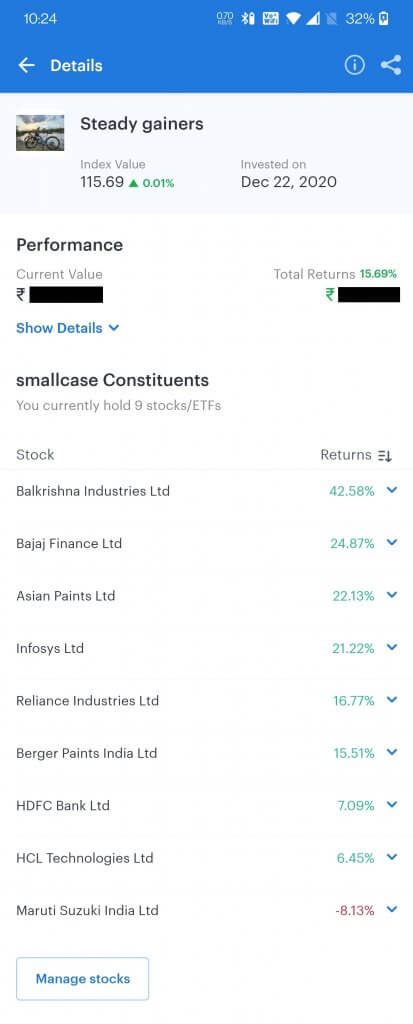
A very good friend of mine experimented with Coffee Can investing portfolio model and created his own smallcase where he is investing in monthly SIPs since October 2020.
What are the disadvantages of Smallcase?
Just like any financial instrument, smallcase has some limitations. It is not suitable for all types of investors.
- It is thematic in nature – Well most of them are. Of course there are exceptions like All weather and some other ETF based, however they are few. Due to the general thematic nature of smallcase, they are not suitable for someone who is beginning their investment journey. Thematic investments are cyclical in nature and hence carry moderately high risk of volatility. As a beginner, one would always do better to invest in safe large cap stocks or mutual funds.
- Requires higher sum for initial investments – Unlike Mutual funds, a small case basket consists of whole stocks. This results in a higher initial investment amount in comparison to mutual funds. Well there are some which start with 200 INR or less than 1000 INR, however, they are ETF based smallcases and not stock based.
- High Subscription cost – This can be a disadvantage if you are not scaling up your investment amount in a subscription fee based smallcase. Let us understand this with an example. Mirae Asset Emerging Blue chip is a Large and Mid-Cap fund, which has a great track record. It has an expense ratio of 0.72% (Direct Plan). Mi_LT_CNX200 is a smallcase from weekend investing that benchmarks itself to large and Mid-cap index. It has a subscription fee of 10,000 INR per year. If I keep the fund / portfolio manager’s strategy and performance aside, one will have to invest at least 14,00,000 INR in the smallcase to have a similar expense ratio. Of course, there are cheaper subscription options available, however, smallcase are generally higher ticket options.
- Not a tax saving instrument – One of the biggest drivers of Equity mutual funds sale are the Equity Linked Saving Schemes (ELSS) funds. They provide a deduction option under 80C for salaried individuals. Smallcase doesn’t have that option.
- Brokerage cost and tax implications due to rebalancing – Brokerage cost isn’t exactly a con, unless one has been living under a rock and hasn’t been using zero brokerage fintech services like Zerodha, 5 Paise etc. Most of the professionally managed smallcases require rebalancing by the portfolio managers quarterly or sometimes even weekly. This exposes the investors to short term capital gains tax at the rate of 15%. In Mutual Funds, rebalancing doesn’t attract STCG tax. Note: STCG would be levied on the gains from individual sell of shares and not the overall portfolio. There still could be some stock which you might be holding in the smallcase for more than a year!
Where should smallcase fit in your portfolio?
No two investors are the same. Everyone has different returns expectations, different risk-taking capacity and are at a different stage of their investment journey. Therefore, no two people will have the same investment strategy. It’s always better to have a mix of asset classes in one’s portfolio. Similarly, it’s always better to have a mix of investing instruments when one wants to have exposure in equity.
The below table gives a comparison of various modes of investing into equity and their attributes:
| Attributes | Direct Stocks | Mutual Funds | Smallcase | PMS |
|---|---|---|---|---|
| Cost Structure | Low (as per brokerage plan) | Low (but hidden cost in the form of expense ratio) | Medium (as per subscription plan and Brokerage partner) | High (Standard upto 2.5% plus performance gains share) |
| Initial Investment / Ticket Size | As small as 1 stock (whether a penny stock or MRF) | Small | Moderate (depending on basket size) | Large (Minimum 50L as per SEBI guidelines |
| Transparency | Complete | Low | Complete | Moderate (Discretionary vs Non-Discretionary portfolio) |
| Liquidity | Easy | Conditional (Exit Load) | Easy | Conditional (Exit Load and minimum balance required) |
| Professional expertise required | Very high | Low to Moderate | Moderate | Low |
| Lock in | None | Only if its ELSS | None | Yes |
| Taxation benefits | None | Only if its ELSS | None | If tax saving instruments are part of PMS |
| Trading | Possible | Not Possible | Not Possible | Not Possible |
Personally, I don’t think smallcase is the right mode to choose if you are at the beginning of your investment journey, as they are very thematic in nature and have a higher ticket size. Yes, there are options available with ETF smallcases, however one doesn’t really need a smallcase for ETF. It’s better to go with mutual funds or buy ETFs directly. I think It is a perfect choice for someone who Is looking to transition from Mutual Funds to Direct Stocks or wants to have a PMS kind of service but doesn’t have the required minimum capital.
Can Smallcase replace Mutual Funds? No. At least not yet. They will have a slice of the market share, however, there will always be a stratum of new and small retail investors who will prefer mutual funds. Also, there is a big market size for ELSS. Smallcase has been providing higher returns on investments compared to mutual funds, hence a slightly higher cost of investment is justified. Although one must keep in mind that most of the smallcase(s) have not been existent for more than 2 years and hence they haven’t gone through complete volatility of market cycles. Trailing returns shown in many cases are back tested on predictive assumption. It doesn’t always factor how the rebalancing would have occurred in the past.
Conclusion
Smallcase is a refreshing introduction into the ever-growing wealth management Fin-tech eco-system and provides something extra for amateur retail investors like me. It is the perfect medium of investing to transition from mutual funds to direct stocks. It is thematic in nature; hence one should do proper due diligence before investing. Just like any other Equity option, it is risky and should be explored with caution, keeping in mind the inherent risks.
Disclaimer: The author is not a SEBI registered research analyst. The contents of this blog are for information and educational purposes. No part of this blog should be considered as investment advice.
Cover Image Source: https://blog.smallcase.com/
Really really good post. Much needed clarity behind smallcases. The table comparing the different investment method based on multiple factors like tradability was quite good. I have been investing in smallcases for about 8-10 months now and can see that the ecosystem will evolve more and more themes and innovative registered analysts/ fund managers will come up with their baskets of happiness 😉
It is a very nice article. Can you please tell me about rebalancing charges for “all weather”?